
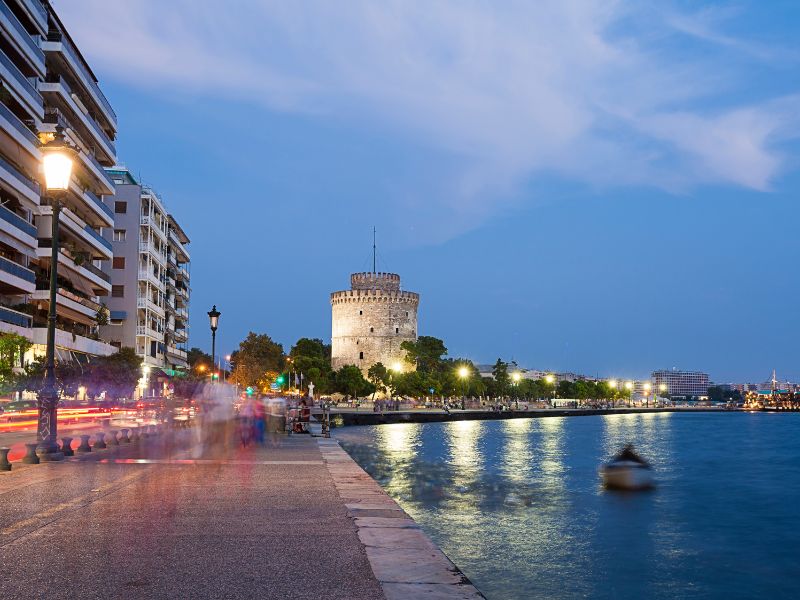
In Thessaloniki, history rarely feels distant. Walk through the city center and you might pass a Roman monument, a Byzantine church, and an Ottoman landmark within just a few blocks. Layers of different civilizations appear almost everywhere.
That is the result of the long history of Thessaloniki. For more than two thousand years the city has stood at a natural crossroads between the Balkans and the Aegean Sea. Merchants arrived through the harbor, armies moved through the region, and entire communities eventually made the city their home.
Each era added something new. Today Thessaloniki still carries traces of all those civilizations.
The story of the city begins in 315 BCE. Cassander, one of Alexander the Great’s successors, decided to establish a new city along the Thermaic Gulf. Instead of building it from nothing, he joined together several smaller settlements that already existed in the area.
He named the new city Thessalonike, after his wife and the half-sister of Alexander the Great. The location quickly proved ideal. Ships could enter the natural harbor easily, while nearby roads connected the region with the interior of Macedonia. Trade grew quickly, and the young city soon became an important center within the Macedonian kingdom.
A major shift came when the Romans expanded into the region. By the 2nd century BCE the city had become part of the Roman Republic. Its importance increased even more after the construction of the Via Egnatia, one of the most important roads of the Roman world.
The road crossed the Balkans and connected the Adriatic Sea with Byzantium. And Thessaloniki sat directly along that route. Travelers, merchants, and soldiers passed through constantly.
The city prospered, and large public buildings began to reshape the urban landscape. Some of those monuments still stand today, including the Arch of Galerius and the massive Rotunda.
When the Roman Empire eventually divided, Thessaloniki remained one of its most important cities. Under Byzantine rule the city became a major center of religion, administration, and commerce. For centuries it ranked just behind Constantinople in importance. Many churches that still define Thessaloniki today were built during this period.
The Church of Saint Demetrius, dedicated to the city’s patron saint, became one of the most important religious sites in the region. Defensive walls also surrounded the city to protect it from repeated attacks. Even today, parts of these Byzantine walls remain visible in the upper districts.
In 1430 the city entered another long chapter when it was captured by the Ottoman Empire. For nearly five centuries Thessaloniki developed as an important Ottoman port city. Different communities lived side by side, including Greeks, Turks, Jews, and others who contributed to the city’s economic and cultural life.
Architecture began to change as well. Mosques, bathhouses, and covered markets appeared across the city. Some buildings from that era still survive, including the historic Bezesteni market. The White Tower, now one of Thessaloniki’s most recognizable landmarks, also dates back to the Ottoman period.
One of the most important communities in the city arrived at the end of the 15th century. In 1492, Sephardic Jews expelled from Spain settled in Thessaloniki and gradually built one of the largest Jewish communities in Europe. For generations, Jewish culture shaped many aspects of the city’s life — especially trade, education, and intellectual activity.
The city eventually became known as the “Jerusalem of the Balkans.” This chapter of Thessaloniki’s history ended tragically during World War II, when most of the Jewish population was deported to Nazi concentration camps, including Auschwitz-Birkenau.
The modern period began in 1912, when Thessaloniki became part of the Greek state after the Balkan Wars. The following decades brought dramatic change. In 1917 a massive fire destroyed much of the historic center. The rebuilding process that followed reshaped the city with a new urban plan and wider streets.
Later events — including World War II and the earthquake of 1978 — also influenced the development of the modern city. Today Thessaloniki is the second largest city in Greece and an important cultural and economic center of northern Greece.
What makes Thessaloniki unique is how visible its past remains.
Roman monuments appear beside Byzantine churches. Ottoman structures stand near modern apartment buildings. Memories of the once-thriving Jewish community continue to shape the identity of the city. Walking through Thessaloniki often feels like moving through a living timeline.
For anyone interested in history, the city offers a rare chance to experience more than two thousand years of civilizations in one place.
We use cookies to improve your experience on our site. By using our site, you consent to cookies.
Manage your cookie preferences below:
Essential cookies enable basic functions and are necessary for the proper function of the website.
Stripe is a payment processing platform that enables businesses to accept online payments securely and efficiently.
Service URL: stripe.com (opens in a new window)
WooCommerce is a customizable eCommerce platform for building online stores using WordPress.
Statistics cookies collect information anonymously. This information helps us understand how visitors use our website.
Google Analytics is a powerful tool that tracks and analyzes website traffic for informed marketing decisions.
Service URL: policies.google.com (opens in a new window)
SourceBuster is used by WooCommerce for order attribution based on user source.
You can find more information in our Privacy Policy and Privacy Policy.