
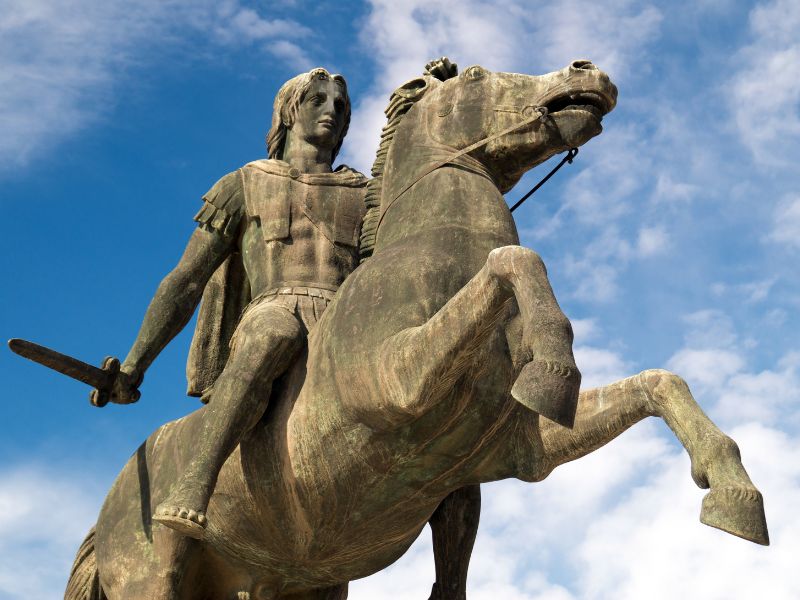
If you walk along Thessaloniki’s waterfront, you eventually meet a familiar figure looking out toward the horizon. The bronze statue of Alexander the Great stands quietly above the promenade, not as a warrior frozen in triumph, but almost as if he’s simply pausing to think. With the sea behind him and the city moving constantly around him, he feels both ancient and strangely present.
The sculpture, created by Evangelos Moustakas, reached this spot in the early 1970s after spending years in storage. Today, thousands pass by it every day — cyclists, students, parents with strollers, joggers chasing the sunset — and somehow the statue blends into the city’s rhythm without losing its weight or meaning.
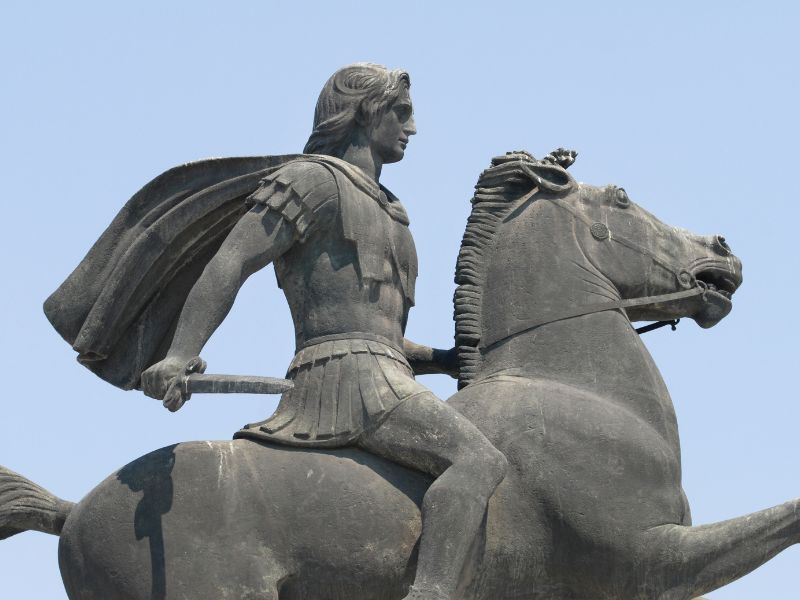
At first glance, it’s the horse you notice — Bucephalus, muscles tense, mane blown back by an imaginary wind. Alexander sits upright, youthful, with the calm confidence that fills so many classical depictions of him. But around the main statue, smaller details create a whole narrative: long bronze spears rising behind him like an honor guard, and carved scenes at the base showing military moments that marked his journey.
These additions turn the monument into something more layered. It is not just a heroic portrait; it’s a reminder that behind every famous name there were decisions, risks, and an enormous movement of people and ideas.
The choice of location wasn’t random. Thessaloniki carries echoes of Alexander’s world — from the name of the city itself to the long cultural memory of Macedonia. Placing Alexander the Great here, facing west over the Thermaic Gulf, ties his legendary expeditions to the geography he once knew intimately.
And practically speaking, the area has become one of the most beloved parts of the city. The statue sits along the New Waterfront, between small themed gardens, open spaces, and the path that stretches from the White Tower to the Concert Hall. People stop here to rest, read, or simply watch the sea change colors throughout the day.
An interesting twist in the statue’s story is that it nearly remained unseen. Moustakas completed the work years before it ever reached the waterfront. For a long time, it stayed in storage as the city searched for a suitable place — somewhere open, prominent, and worthy of its scale.
Only when Thessaloniki redesigned its seafront did the statue finally get the home it deserved. The decision to place it outdoors, freely accessible, reflects the city’s belief that public space should belong to everyone, and that iconic figures of Hellenic history should be part of everyday life, not hidden behind museum doors.
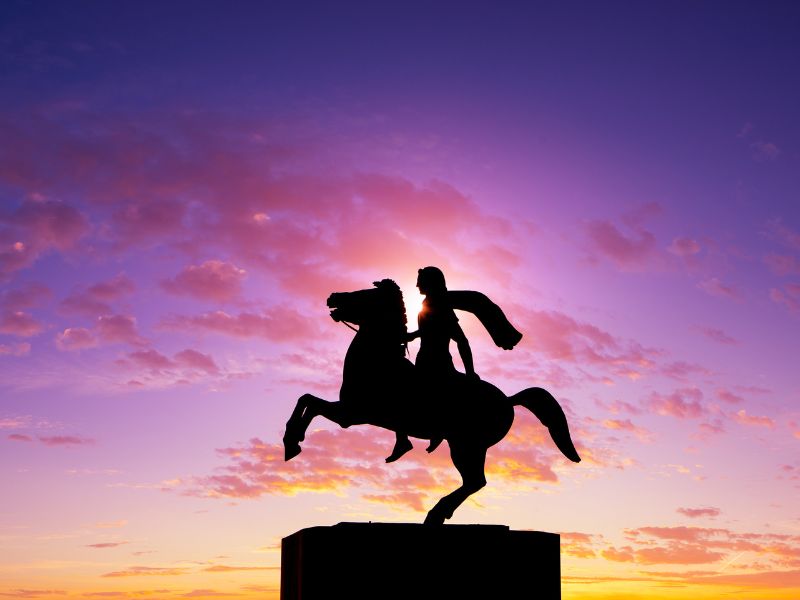
It’s hard not to stop here, especially during sunset. The silhouette of Alexander the Great becomes dramatic against the fading light, and Bucephalus seems almost ready to leap forward. Visitors snap photos, couples sit on the low walls, and sometimes you’ll see someone simply staring out at the water, lost in thought.
It’s one of those places where history doesn’t feel distant — it feels like a companion for a brief moment.
Useful notes for visitors:
What makes this monument special isn’t only its artistic quality. It’s the way it fits Thessaloniki’s identity. The city has always been a meeting point of cultures — Greek, Roman, Byzantine, Ottoman — and the statue of Alexander the Great feels like an anchor in this long historical chain.
It doesn’t glorify battles. It doesn’t dominate the space. Instead, it stands quietly by the sea, suggesting that exploration, curiosity, and openness to the wider world still matter today just as they did in Alexander’s time.
In that sense, the statue is not just a reminder of the past. It’s an invitation to look outward — toward the horizon, toward possibility, toward whatever comes next.
We use cookies to improve your experience on our site. By using our site, you consent to cookies.
Manage your cookie preferences below:
Essential cookies enable basic functions and are necessary for the proper function of the website.
Stripe is a payment processing platform that enables businesses to accept online payments securely and efficiently.
Service URL: stripe.com (opens in a new window)
WooCommerce is a customizable eCommerce platform for building online stores using WordPress.
Statistics cookies collect information anonymously. This information helps us understand how visitors use our website.
Google Analytics is a powerful tool that tracks and analyzes website traffic for informed marketing decisions.
Service URL: policies.google.com (opens in a new window)
SourceBuster is used by WooCommerce for order attribution based on user source.
You can find more information in our Privacy Policy and Privacy Policy.