
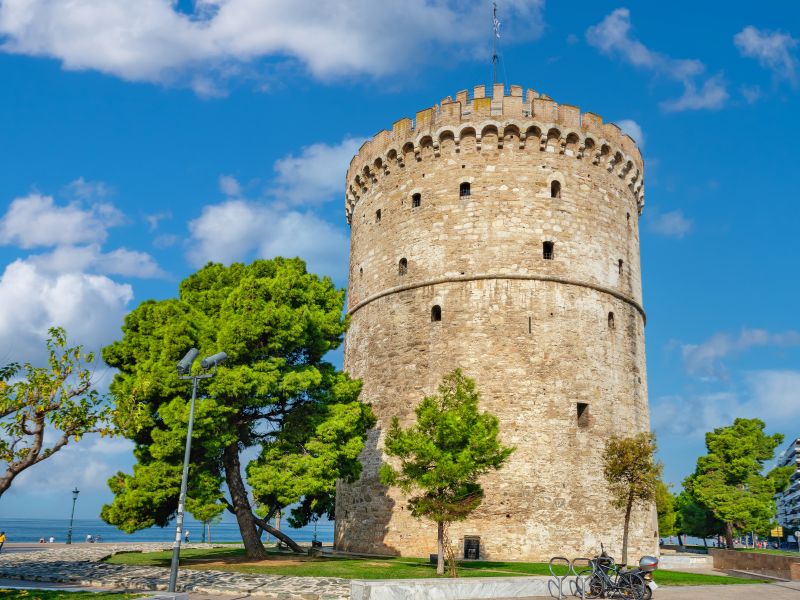
Right where Thessaloniki meets the water, a round stone tower rises quietly above the promenade. The White Tower of Thessaloniki is the city’s unofficial signature — the building most people first picture when they think of the northern capital. Its shape appears on magnets, T-shirts, murals, and just about every travel photo ever taken here.
But long before it became a friendly landmark, it lived a far harsher life. Behind today’s calm exterior hides a story full of soldiers, prisoners, shifting empires, and the slow transformation of a feared fortress into a beloved symbol.
The structure standing today dates to the late 1400s, when the Ottomans rebuilt the old Byzantine fortifications to strengthen the eastern edge of the city. From this strategic point, they could watch the harbor, control sea traffic, and keep an eye on any unrest inside the walls.
For centuries, the tower served double duty: lookout post above, prison below. Its thick circular walls, built for defense, created dark inner chambers that became infamous. Records and travelers’ accounts refer to it not as the White Tower but as something far more unsettling — the “Tower of Blood,” a grim reference to the executions and punishments carried out within.
By the 19th century, the reputation of the White Tower of Thessaloniki had become a burden. At some point, it was painted white — perhaps as part of a renovation, perhaps as an attempt to erase the fear associated with it. A popular story claims that one imprisoned man was released after painting it himself, though historians treat this more as folklore than fact.
Whatever the truth, the new appearance stuck, and so did the name. When Thessaloniki passed into Greek hands in 1912, the White Tower of Thessaloniki quickly became a symbol of the city’s new chapter. What had once defended an empire now represented a free northern metropolis ready for its next era.
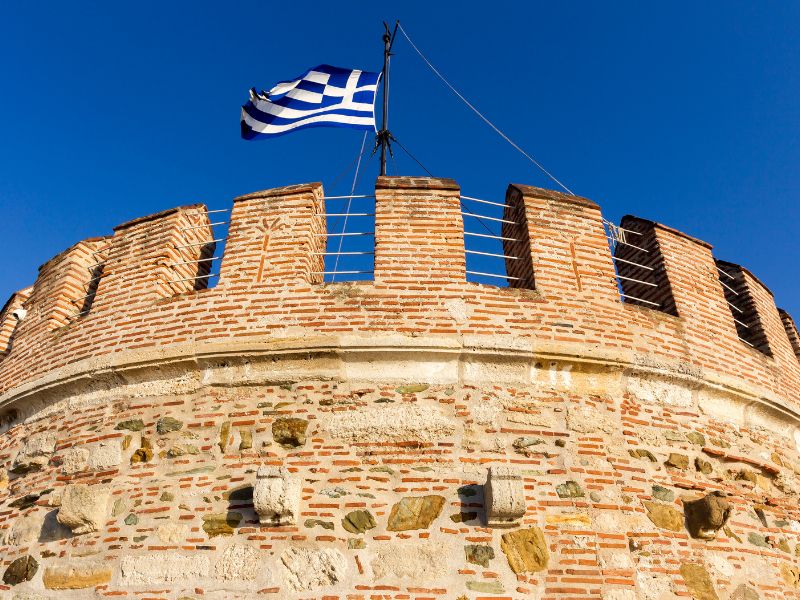
Visitors entering the tower today encounter a completely different world. Instead of chains and guards, the interior holds a compact museum dedicated to Thessaloniki’s long history. Each floor focuses on a different chapter:
A winding stone staircase leads all the way to the top. The final reward is the open-air terrace — one of the best viewpoints in the city. From here, you can see the whole curve of the Gulf, Mount Olympus on a clear day, and the entire stretch of the waterfront buzzing with activity.
The area around the tower is one of the liveliest spots in Thessaloniki. Street musicians play, cyclists weave along the promenade, and groups of students sit on the benches facing the water. Despite this constant movement, the tower itself seems completely still, an anchor between the sea and the city.
The contrast between its turbulent past and today’s relaxed atmosphere is one of the things that makes it so compelling.
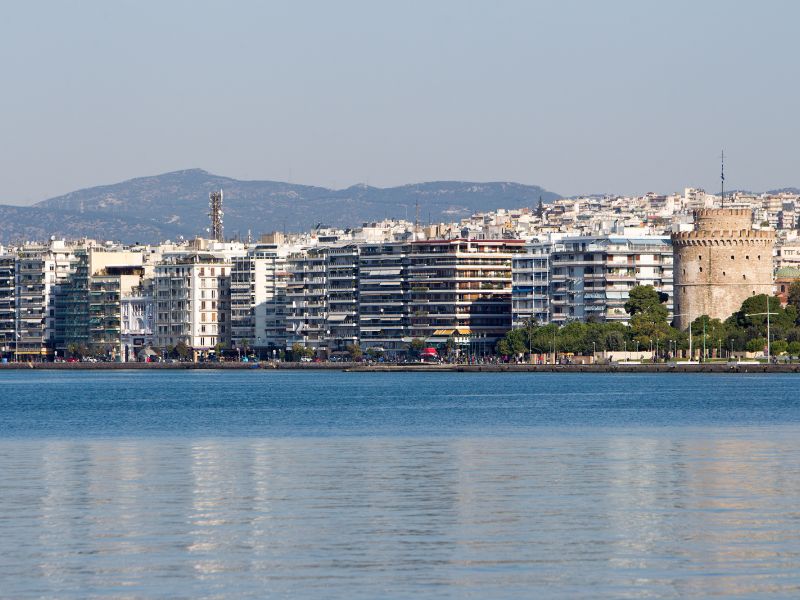
Thessaloniki has always been a meeting place for cultures — Roman officials, Byzantine clergy, Ottoman administrators, Jewish merchants, Balkan travelers, and later, modern Greek citizens. The White Tower reflects that layered identity better than almost any other building.
It serves many roles at once:
Its story ties together the city’s difficult moments and its brighter ones, reminding everyone who passes that Thessaloniki has learned to adapt, survive, and reinvent itself.
During major festivals and sports events, the tower becomes the city’s unofficial meeting spot — and appears in an astonishing number of photos. Its silhouette is so recognizable that it has quietly become one of the most frequently photographed structures in Greece.
No visit to Thessaloniki feels complete without stopping here. The White Tower marks the beginning of the seaside walk that leads past gardens, sculptures, and open-air spaces all the way to the Concert Hall. It’s an easy first step into understanding the city’s character — part maritime, part historical, part youthful energy.
The White Tower of Thessaloniki has been many things: fortress, prison, watchtower, symbol of power, and now a beloved landmark. It watched centuries unfold and still stands calmly at the water’s edge, holding the city’s memories in its stone layers.
In many ways, its story mirrors the story of Thessaloniki itself — resilient, restless, and forever shaped by the sea.
We use cookies to improve your experience on our site. By using our site, you consent to cookies.
Manage your cookie preferences below:
Essential cookies enable basic functions and are necessary for the proper function of the website.
Stripe is a payment processing platform that enables businesses to accept online payments securely and efficiently.
Service URL: stripe.com (opens in a new window)
WooCommerce is a customizable eCommerce platform for building online stores using WordPress.
Statistics cookies collect information anonymously. This information helps us understand how visitors use our website.
Google Analytics is a powerful tool that tracks and analyzes website traffic for informed marketing decisions.
Service URL: policies.google.com (opens in a new window)
SourceBuster is used by WooCommerce for order attribution based on user source.
You can find more information in our Privacy Policy and Privacy Policy.