
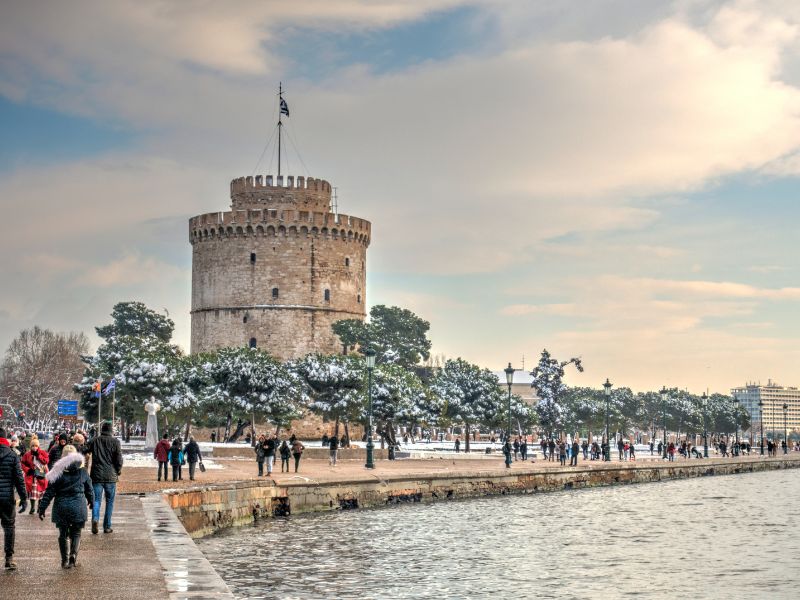
Quiet, round, and almost modest at first glance, the White Tower stands at the edge of Thessaloniki’s waterfront like a patient guardian. It’s not just another monument — locals treat it as the city’s unofficial emblem. Every guidebook, every walking tour, somehow begins here. Yet behind the famous silhouette lies a complicated and sometimes dark past, shaped by war, shifting empires, and the city’s own reinvention.
The tower we see today was completed in the late 15th century by the Ottomans, replacing an older Byzantine fortification. Its position was no accident: right on the eastern wall, facing the harbor, it was meant to control and intimidate.
For decades it served a double purpose — a military lookout and a prison. Soldiers watched the sea from its battlements, while prisoners endured grim conditions inside its thick stone walls.
And the name “White Tower”? Definitely not its original. For centuries it was known as the “Tower of Blood,” a reference to the executions carried out within.
Sometime in the 19th century, the tower underwent a symbolic cleansing. One widely repeated story tells of a prisoner who earned his freedom by painting the entire tower white, washing away its brutal associations. Whether the tale is true or not, it explains how the nickname stuck.
After the city’s liberation in 1912, the tower gained new meaning — a monument no longer tied to fear, but to memory and identity. Thessaloniki finally made it its own.
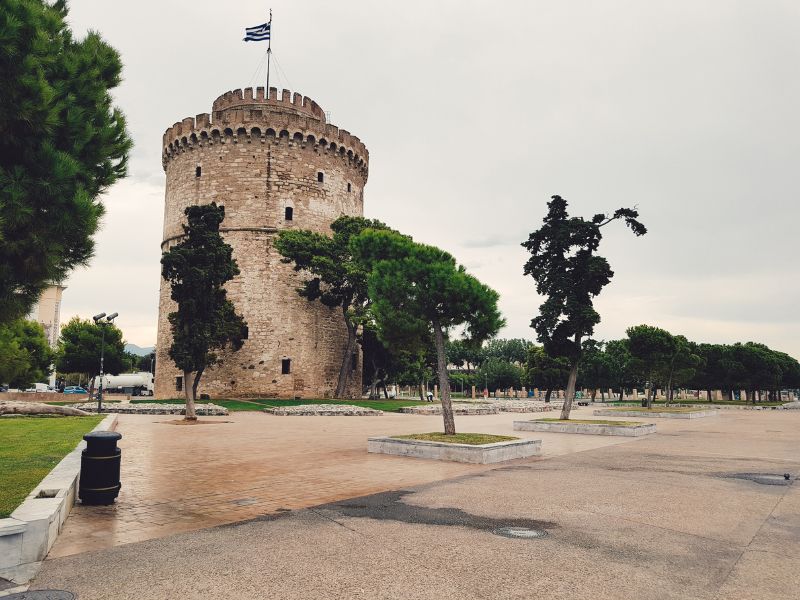
Now the tower is one of the most visited spots in the city. Its interior holds a compact museum curated by the Ephorate of Antiquities. As you climb the spiral staircase, each floor presents a different chapter of Thessaloniki’s long history:
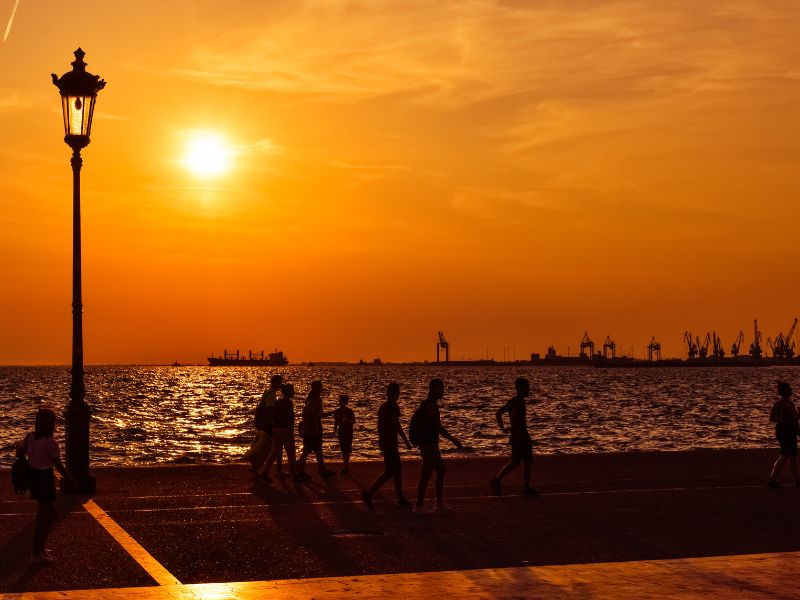
Most visitors, however, remember the rooftop best. From the open terrace, the view stretches across the Thermaic Gulf, and at sunset the whole scene glows as the sea reflects shades of gold and rose.
The plaza around the tower never really stops moving. Street performers set up nearby, cyclists roll past, and tourists pause constantly for photos. It also marks the beginning of the famous Thessaloniki Waterfront Walk, the long seaside promenade leading all the way to the Concert Hall.
Despite all the activity, the tower remains still — the city’s anchor, both in geography and in memory.
Practical info
🎟️ €6 entrance (reduced €3)
🕒 08:00–20:00 in summer; 08:00–15:00 in winter
📍 Easy walking distance from the city center
Thessaloniki has always been a meeting point of cultures — Roman, Byzantine, Ottoman, Jewish, Balkan, and Greek. The White Tower reflects that blend. Within one structure are layers of conquest, resilience, and transformation.
It stands today as:
It connects emperors and prisoners, battles and peaceful sunsets, foreign rulers and modern citizens.
In nearly every film or series set in Thessaloniki, the White Tower appears somewhere — a background silhouette, a cutaway shot, a symbol meant to place the viewer instantly in the city.
Anyone exploring Thessaloniki should start here. From the tower, visitors can continue along the New Waterfront toward themed gardens, Zongolopoulos’ Umbrellas, and the statue of Alexander the Great.
More than a pretty backdrop, the White Tower offers a narrative — a way to understand the city and its shifting identity.
The White Tower isn’t just a monument; it’s a survivor. It has seen empires collapse, revolutions unfold, and a modern city rise around it. From feared prison to beloved landmark, it mirrors the character of Thessaloniki itself: adaptable, resilient, and always leaning toward the sea.
We use cookies to improve your experience on our site. By using our site, you consent to cookies.
Manage your cookie preferences below:
Essential cookies enable basic functions and are necessary for the proper function of the website.
Stripe is a payment processing platform that enables businesses to accept online payments securely and efficiently.
Service URL: stripe.com (opens in a new window)
WooCommerce is a customizable eCommerce platform for building online stores using WordPress.
Statistics cookies collect information anonymously. This information helps us understand how visitors use our website.
Google Analytics is a powerful tool that tracks and analyzes website traffic for informed marketing decisions.
Service URL: policies.google.com (opens in a new window)
SourceBuster is used by WooCommerce for order attribution based on user source.
You can find more information in our Privacy Policy and Privacy Policy.