
At the beginning of the 4th century CE, Thessaloniki became one of the most important cities in the Roman Balkans. Much of that development is connected to the ambitions of the Roman emperor Galerius.
Galerius chose Thessaloniki as one of his imperial residences and began a major building program in the city. Entire sections of the urban landscape were redesigned. Monumental buildings appeared, public spaces were reorganized, and ceremonial routes were created to connect the different structures.The result was an impressive imperial complex, the Galerius Palace Complex in Thessaloniki.
During this period the Roman Empire was ruled under the system known as the Tetrarchy. Instead of a single emperor, several rulers governed different regions of the empire at the same time. Galerius controlled the Balkan territories. For this reason he needed a strong administrative center in the region.
Thessaloniki offered several advantages. It stood directly along the Via Egnatia, one of the most important roads of the Roman Empire. The city also had a major harbor on the Aegean Sea, allowing communication with other parts of the Mediterranean.
At the same time, Thessaloniki already possessed defensive walls and a well-developed urban infrastructure. For an emperor looking to establish a regional center of power, the choice made sense.
The Galerius Palace Complex in Thessaloniki was not a single building. Instead, it consisted of several monumental structures arranged across a large part of the city. The complex included administrative buildings, imperial residences, religious spaces, and large ceremonial areas. Roads connected these buildings and created a clear route through the district.
It was carefully planned.The architecture and layout were designed not only for practical use but also to display imperial authority. Anyone moving through the area would immediately see the scale of Roman power.
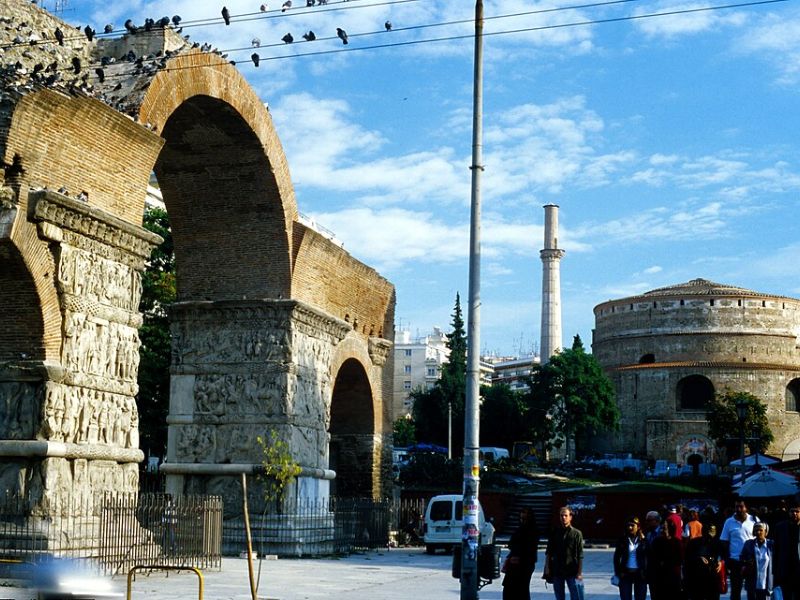
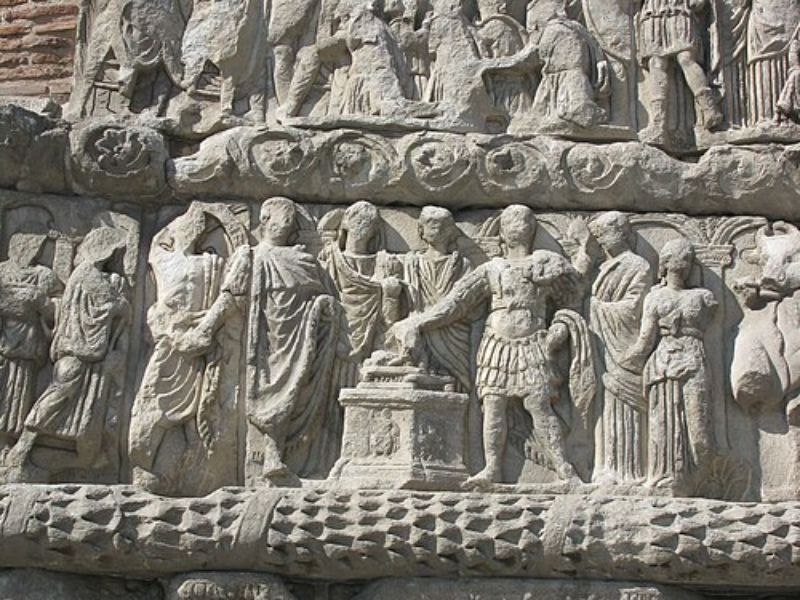
One of the most famous monuments connected with this complex is the Arch of Galerius. The arch was constructed around 305 CE to commemorate Galerius’s victory against the Persian Empire. Carved reliefs still visible on the monument depict scenes of battle, Roman soldiers, and imperial ceremonies celebrating the triumph.
In antiquity, the arch stood along a major ceremonial route that linked the Galerius Palace Complex in Thessaloniki with other important structures. Today it remains one of the best-known Roman landmarks in Thessaloniki.
Not far from the arch stands another remarkable structure: the Rotunda. The building dates from the same period and is one of the most impressive Roman constructions still standing in Greece. Its enormous dome and extremely thick walls allowed it to survive centuries of earthquakes, political change, and urban development.
The original function of the Rotunda is still debated. Some historians believe it was designed as a mausoleum for Galerius. Others suggest that it may have been built as a temple connected to the imperial complex.
Whatever its original role, the building later served many different purposes. During the Byzantine period it became a church, and under Ottoman rule it was converted into a mosque.
The monuments built by Galerius were connected through a ceremonial route running across the city. This route linked the imperial palace area with the Arch of Galerius and the Rotunda. During official ceremonies, the emperor and his entourage would have moved along this path.
Such processional routes were common in major Roman cities.They allowed emperors to demonstrate their authority in a public and highly visible way.
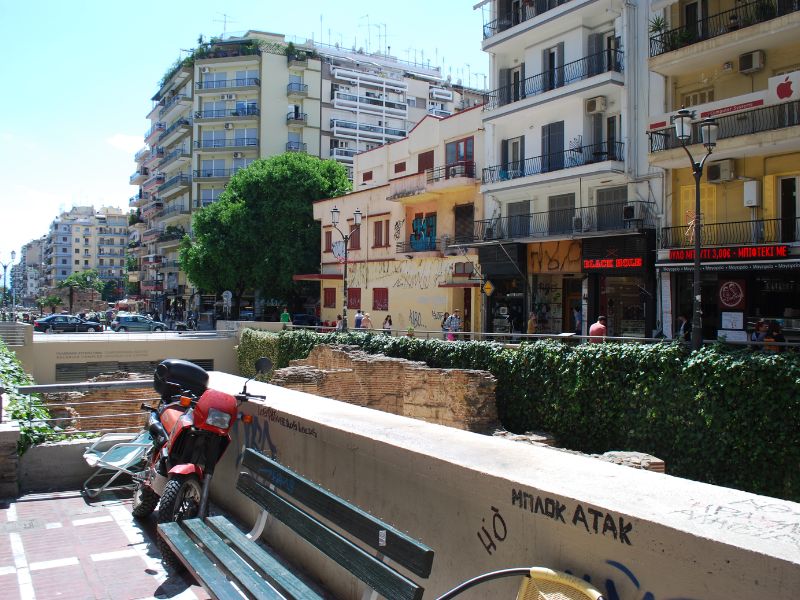
Today, parts of the Galerius Palace Complex in Thessaloniki can still be seen in the center of Thessaloniki. Archaeological excavations have revealed sections of palace buildings, courtyards, and detailed floor mosaics that once decorated the imperial residence. Although only fragments remain, they give an impression of the scale of the complex.
Walking through these ruins today, it is possible to imagine how impressive the district must have looked during the Roman period.
The construction program initiated by Galerius left a lasting imprint on Thessaloniki. Many of the monuments that define the historic center of the city today originate from this period. The arch, the Rotunda, and the remains of the Galerius Palace Complex in Thessaloniki still shape the urban landscape.
Through these projects, Galerius effectively transformed Thessaloniki into an imperial center of the Roman Balkans. The influence of that transformation can still be seen in the city nearly two thousand years later.
We use cookies to improve your experience on our site. By using our site, you consent to cookies.
Manage your cookie preferences below:
Essential cookies enable basic functions and are necessary for the proper function of the website.
Stripe is a payment processing platform that enables businesses to accept online payments securely and efficiently.
Service URL: stripe.com (opens in a new window)
WooCommerce is a customizable eCommerce platform for building online stores using WordPress.
Statistics cookies collect information anonymously. This information helps us understand how visitors use our website.
Google Analytics is a powerful tool that tracks and analyzes website traffic for informed marketing decisions.
Service URL: policies.google.com (opens in a new window)
SourceBuster is used by WooCommerce for order attribution based on user source.
You can find more information in our Privacy Policy and Privacy Policy.