

Many visitors exploring Thessaloniki are surprised to learn that the city once had one of the largest Jewish communities in Europe.
For centuries, Jewish culture was deeply woven into the life of the city. Markets, schools, printing houses, and entire neighborhoods were shaped by the Sephardic Jews who made Thessaloniki their home. Today, much of that world exists only in historical memory.
The Jewish Museum of Thessaloniki helps bring that history back to life. Located in the city center, the museum tells the story of a community that flourished here for hundreds of years and played a major role in shaping the character of Thessaloniki.
The story of Jewish Thessaloniki begins in the late 15th century.
In 1492, the Spanish Crown expelled Jews from Spain. Many families fled across the Mediterranean and eventually found refuge in the Ottoman Empire. Thessaloniki became one of the main places where they settled.
Over time, the Sephardic Jewish community grew quickly. By the 16th century, Jews made up a large part of the city’s population.
They brought with them traditions, language, and skills that influenced the city for generations. The Ladino language — a form of medieval Spanish — became widely spoken. Jewish merchants helped build strong trade networks across the Mediterranean, and the community developed a rich intellectual and cultural life.
Because of this vibrant Jewish presence, Thessaloniki was often called the “Jerusalem of the Balkans.”
The long history of the Jewish community in Thessaloniki came to a devastating turning point during World War II.
In 1943, under Nazi occupation, thousands of Jewish residents were deported to concentration camps, primarily Auschwitz-Birkenau. Entire families disappeared within months.
Before the war, Jews had represented a significant part of the city’s population. After the deportations, the centuries-old community was almost entirely destroyed.
Today, the Jewish Museum of Thessaloniki preserves the memory of those who lived in the city and honors the lives that were lost.

Walking through the museum feels less like visiting a traditional exhibition and more like discovering fragments of a vanished world.
Photographs show the Jewish neighborhoods that once filled the city. Old documents and family records reveal how people lived, worked, and celebrated their traditions.
Visitors can see religious objects, synagogue artifacts, and historical documents written in Ladino. Personal testimonies from Holocaust survivors add a deeply human dimension to the story.
Together, these collections recreate the atmosphere of a community that shaped Thessaloniki for centuries.
One of the most important stories connected to the museum is the destruction of the historic Jewish cemetery.
For hundreds of years, Thessaloniki’s Jewish cemetery was one of the largest in Europe. During the German occupation in World War II, the cemetery was destroyed and many gravestones were removed or reused in construction projects.
Today, the land where the cemetery once stood is part of the campus of Aristotle University.
The museum preserves the memory of this lost cemetery through historical records and research.
The museum is located in the historic commercial district near the city’s old market area and the port.
The building itself is a restored commercial structure that once belonged to a Jewish-owned business. Its location makes it easy to include the museum in a walking tour of the city center.
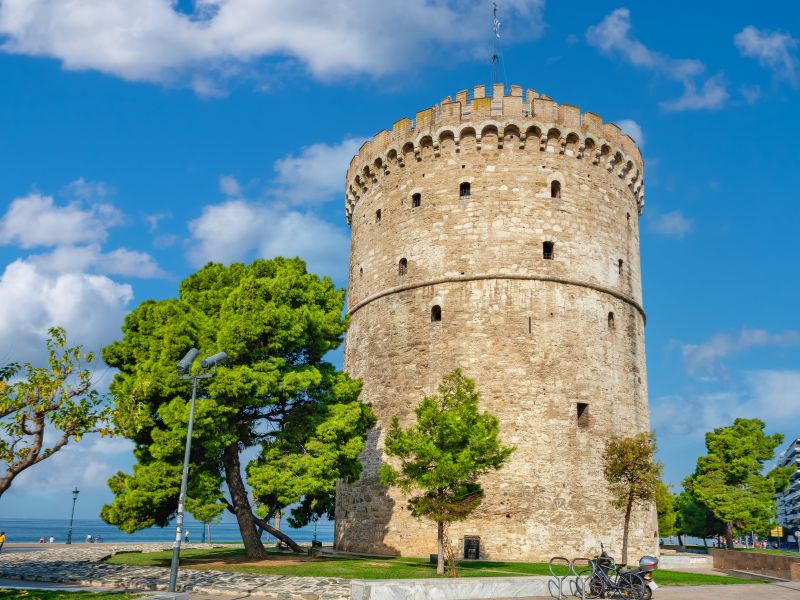
After visiting, many travelers continue exploring nearby landmarks such as the waterfront promenade or the White Tower.
Understanding Thessaloniki means understanding the many communities that helped shape it.
For centuries, Jewish culture played a central role in the city’s identity, economy, and intellectual life. Although much of that world disappeared during the war, its history remains an essential part of Thessaloniki’s story.
The Jewish Museum of Thessaloniki ensures that this history is remembered and that the voices of the community continue to be heard.
We use cookies to improve your experience on our site. By using our site, you consent to cookies.
Manage your cookie preferences below:
Essential cookies enable basic functions and are necessary for the proper function of the website.
Stripe is a payment processing platform that enables businesses to accept online payments securely and efficiently.
Service URL: stripe.com (opens in a new window)
WooCommerce is a customizable eCommerce platform for building online stores using WordPress.
Statistics cookies collect information anonymously. This information helps us understand how visitors use our website.
Google Analytics is a powerful tool that tracks and analyzes website traffic for informed marketing decisions.
Service URL: policies.google.com (opens in a new window)
SourceBuster is used by WooCommerce for order attribution based on user source.
You can find more information in our Privacy Policy and Privacy Policy.