
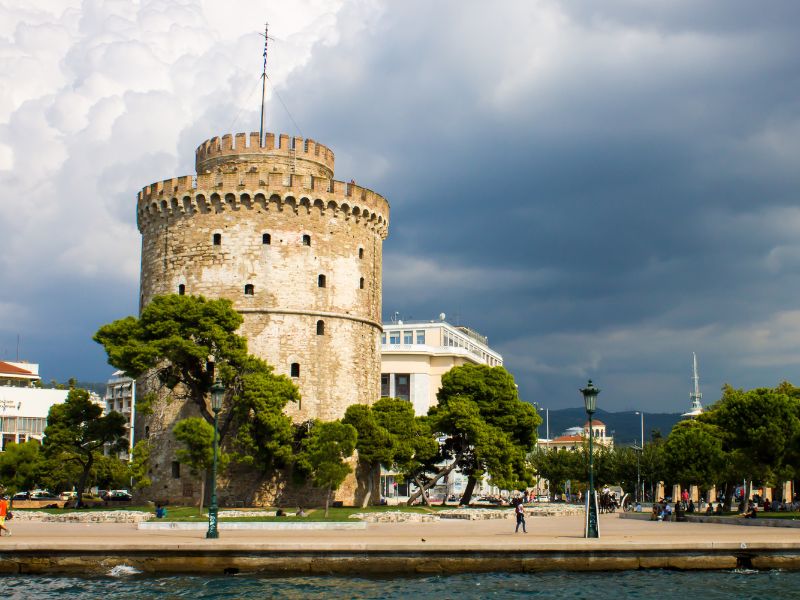
Walk through the center of Thessaloniki today and it’s easy to forget how old the city really is. Modern streets, cafés, and apartment buildings cover layers of history that go back more than two thousand years.
The story of Ancient Thessaloniki begins in 315 BCE, when the Macedonian ruler Cassander founded the city along the shores of the Thermaic Gulf.
At the time, the Greek world was going through a dramatic transformation. Alexander the Great had died only a few years earlier, and his vast empire was already breaking apart as rival generals fought for power.
Amid that uncertain political landscape, a new city appeared on the northern coast of the Aegean.

Cassander did not choose the location by chance. The coastline of the Thermaic Gulf offered a naturally protected harbor, making it an ideal place for trade and communication. At the same time, important land routes connected the region with inland Macedonia and the Balkans.
There was another practical advantage. Several small settlements already existed in the surrounding area. Instead of building a completely new city from nothing, Cassander united these communities into a single urban center. That decision created the foundations of Ancient Thessaloniki.
Unlike older Greek settlements that developed gradually over centuries, Thessaloniki was planned from the beginning as an organized city.
Most historians believe its layout followed the Hippodamian grid system. Streets were arranged in straight lines that intersected at right angles, creating clearly defined neighborhoods.
At the center stood the agora.This open square served as the heart of public life. Merchants traded goods there, citizens gathered to discuss political matters, and travelers passing through the city often stopped in the same space.
Around the agora, residential districts slowly expanded as the population grew.
Of course, the harbor changed everything. Ships could easily travel between Thessaloniki and other ports of the Aegean Sea. Merchants arrived with wine, grain, pottery, and textiles moving through Mediterranean trade networks.
Trade routes extended north as well. Through these connections the city linked coastal Greece with the Balkan interior, allowing merchants and travelers to move between regions. Over time the harbor became the economic center of the city.
Daily life in Ancient Thessaloniki reflected the cultural traditions of the Greek world. Public activity often revolved around the agora, where people met not only to buy and sell goods but also to exchange news and discuss politics. Temples and public buildings likely stood nearby, shaping the character of the city.
Much of this early architecture now lies beneath the modern city. Still, archaeological discoveries continue to reveal pieces of that early urban landscape.
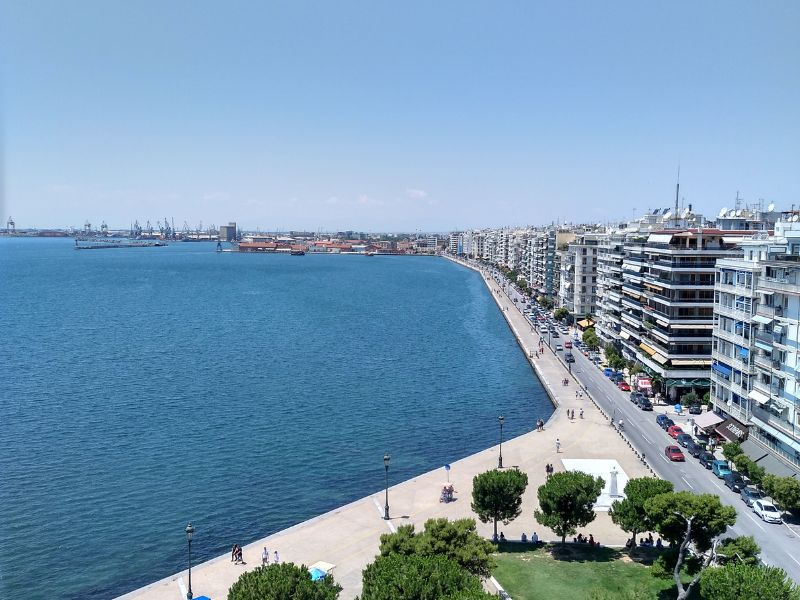
By the 2nd century BCE, political power in the region began to shift again. Rome gradually expanded into Macedonia and eventually incorporated the territory into the Roman Republic. For Thessaloniki, however, this change brought new opportunities rather than decline.
A major Roman road, the Via Egnatia, passed directly through the city. This route connected the Adriatic Sea with Byzantium and turned Thessaloniki into one of the main transportation and trade hubs of the Roman Balkans.
The foundations established during the Hellenistic period shaped the future of the city. The organized street plan, the strategic harbor, and the city’s position along major trade routes allowed Thessaloniki to grow steadily under later empires.
In the centuries that followed, the city would become a major Roman metropolis and later one of the most important urban centers of the Byzantine world. Even today, much of modern Thessaloniki still stands above the remains of Ancient Thessaloniki, the city that Cassander founded more than two thousand years ago.
We use cookies to improve your experience on our site. By using our site, you consent to cookies.
Manage your cookie preferences below:
Essential cookies enable basic functions and are necessary for the proper function of the website.
Stripe is a payment processing platform that enables businesses to accept online payments securely and efficiently.
Service URL: stripe.com (opens in a new window)
WooCommerce is a customizable eCommerce platform for building online stores using WordPress.
Statistics cookies collect information anonymously. This information helps us understand how visitors use our website.
Google Analytics is a powerful tool that tracks and analyzes website traffic for informed marketing decisions.
Service URL: policies.google.com (opens in a new window)
SourceBuster is used by WooCommerce for order attribution based on user source.
You can find more information in our Privacy Policy and Privacy Policy.