
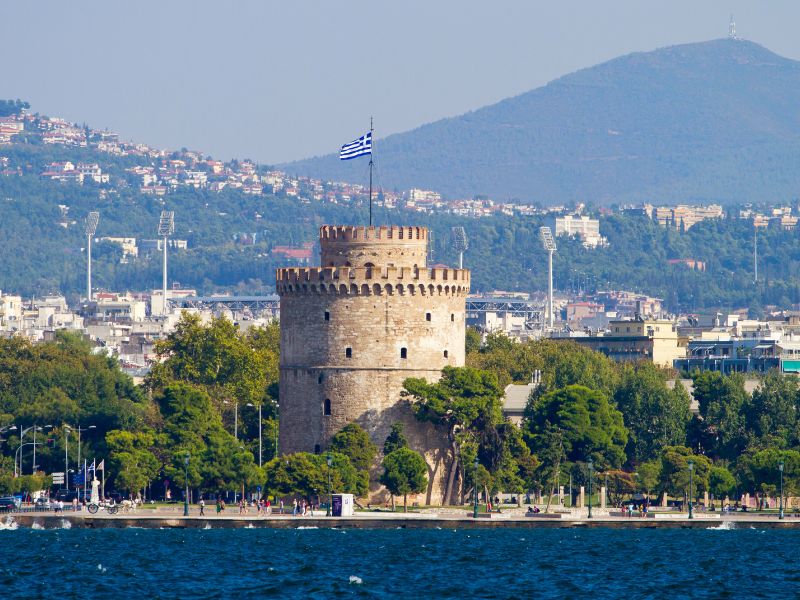
When Macedonia was absorbed into the Roman Empire during the 2nd century BCE, Thessaloniki was already an active harbor on the northern Aegean coast. Even then, the city had begun to grow. Roman rule, however, pushed that development much further.
Its position mattered a great deal. Thessaloniki stood between the Balkan interior and the Aegean Sea, which naturally turned it into a crossroads for trade and movement. Ships arrived regularly from different parts of the Mediterranean, bringing goods, merchants, and travelers. The streets would have been busy—filled with traders negotiating prices, officials moving between provinces, and soldiers passing through.
Over time the city became far more than a simple port. Roman Thessaloniki developed into one of the most important urban centers in the Balkans, both commercially and administratively.
One of the most important reasons for the growth of Roman Thessaloniki was the construction of the Via Egnatia.
This long Roman road crossed the Balkan Peninsula and linked the Adriatic Sea with the eastern territories of the empire. As it passed through Macedonia, the route ran directly through Thessaloniki. That single detail changed the city’s future.
Merchants moving goods across the Balkans used this road constantly. Roman officials traveled along it when moving between provincial centers, and military units relied on it when crossing imperial territory. Because of that steady traffic, Thessaloniki slowly developed into a key stop along the route.
The Via Egnatia did more than connect regions. In many ways, it helped shape the daily life and rhythm of Roman Thessaloniki.
The city entered another important phase during the early 4th century CE under the Roman emperor Galerius.
Galerius selected Thessaloniki as one of his imperial residences. That decision triggered a major wave of construction throughout parts of the city. Large buildings appeared, and a new imperial complex began to take shape.
These projects changed the urban landscape in visible ways. Although centuries have passed since then, several of those structures still survive. They remain among the clearest reminders of Thessaloniki’s importance during the later Roman period.
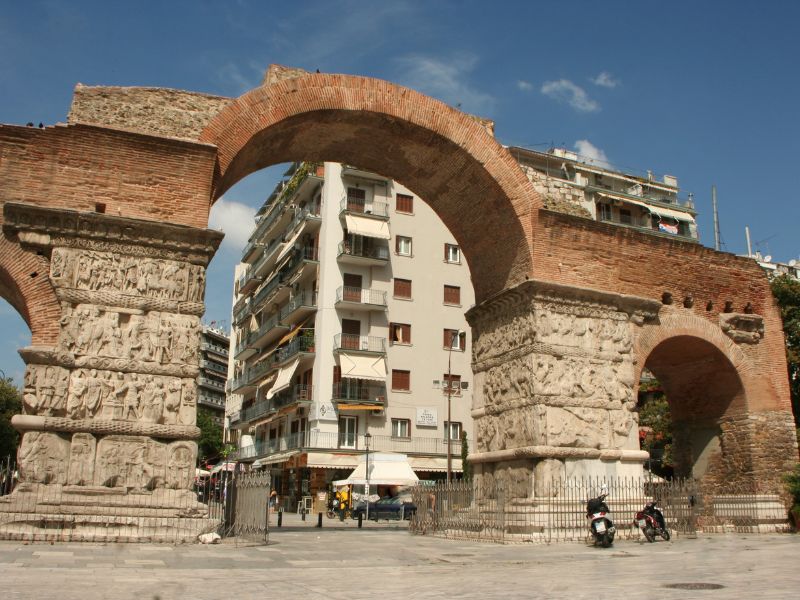
One of the most recognizable monuments from this era is the Arch of Galerius.
The arch was built in the early 4th century CE to commemorate Galerius’s victories against the Persian Empire. Detailed reliefs carved into the stone still depict scenes from these campaigns. Soldiers, emperors, and ceremonial processions appear across its surfaces.
In antiquity, the monument stood along a ceremonial route that connected several buildings of the imperial complex. Anyone walking through this part of the city would have passed beneath it.
Even today, despite the damage of time, the arch remains one of the most distinctive landmarks connected to Roman Thessaloniki.
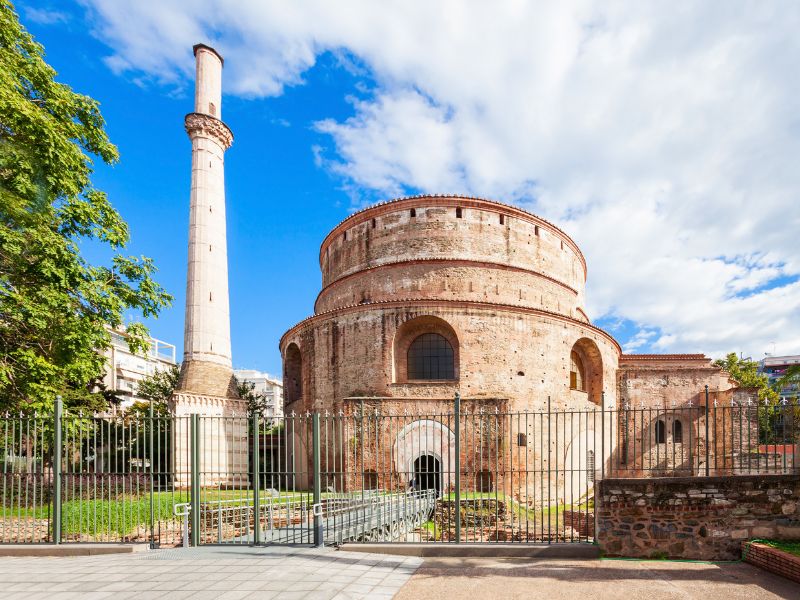
A short walk from the arch stands the Rotunda, one of the most impressive ancient structures in the city.
The building dates to the reign of Galerius and is remarkable for its massive dome and thick stone walls. These features helped it survive earthquakes, wars, and centuries of change.
Its original purpose is still debated by historians. Some believe it was intended as a mausoleum for the emperor. Others argue that it may have been built as a temple.
What is certain is that the Rotunda did not remain unchanged. Over time it served different religious roles, reflecting the evolving history of Thessaloniki itself.
At the center of public life in Roman Thessaloniki stood the Roman Forum.
This large complex functioned as the civic heart of the city. Administrative buildings, public squares, and commercial areas were all located here. Citizens gathered to conduct business, discuss political matters, and participate in everyday social activities.
Excavations carried out in modern times have revealed a surprisingly large structure. Archaeologists uncovered colonnaded walkways, open courtyards, and underground passages that once supported the buildings above.
These remains provide a vivid picture of how public life once unfolded in Roman Thessaloniki.
Roman Thessaloniki also played a role in the early spread of Christianity.
The city is mentioned in the New Testament through letters written by Paul the Apostle to the local Christian community. These texts are known as the Epistles to the Thessalonians.
Their existence shows that a Christian community had already formed in the city during the Roman period. From Thessaloniki, early Christian teachings continued to spread across the wider region.
The Roman era left a lasting imprint on Thessaloniki that is still visible today.
Modern buildings now stand beside monuments that date back nearly two thousand years. Visitors walking through the city can still encounter the Arch of Galerius, the Rotunda, and the remains of the Roman Forum.
These structures reveal how important Thessaloniki once was within the Roman world. More importantly, they allow modern travelers to experience the many historical layers that continue to shape the identity of the city.
We use cookies to improve your experience on our site. By using our site, you consent to cookies.
Manage your cookie preferences below:
Essential cookies enable basic functions and are necessary for the proper function of the website.
Stripe is a payment processing platform that enables businesses to accept online payments securely and efficiently.
Service URL: stripe.com (opens in a new window)
WooCommerce is a customizable eCommerce platform for building online stores using WordPress.
Statistics cookies collect information anonymously. This information helps us understand how visitors use our website.
Google Analytics is a powerful tool that tracks and analyzes website traffic for informed marketing decisions.
Service URL: policies.google.com (opens in a new window)
SourceBuster is used by WooCommerce for order attribution based on user source.
You can find more information in our Privacy Policy and Privacy Policy.